Monday, July 4, 2022

The ghost of Darwin is everywhere here: LSU in the Galápagos


From June 7th to the 24th this year, I was able to travel to Ecuador and the Galápagos Islands as an instructor for two LSU Study Abroad classes, including
Evolution. I have wanted to teach evolution in the Galápagos for some time, in fact this Study Abroad course was first planned for 2020 but cancelled twice due to COVID. It was therefore quite the relief to finally get to go this summer; and it was an absolute delight. This was the thirty-sixth country that I’ve visited (most of them for research) and the Galápagos Islands will be among my favorites for many reasons that I will get to shortly. I’m grateful that Dr. Dan Holstein, from the LSU College of the Coast & Environment, who has worked there several times, was there to show me the ropes. Dan and I brought seven LSU undergraduate students with us, and as an added bonus - my family joined us for the first part of the trip in San Cristóbal.

            Dan is a marine biologist, and an incredible swimmer, so many of the activities he arranged were snorkeling fish surveys – something right up my alley. Despite their tropical location, the Galápagos Islands actually have rather cool marine waters surrounding it, something Dan studies for his research; we learned from him how the many continuingly changing currents impact the marine life. That includes the famous Humboldt Current bringing cold Southern Ocean waters up to equatorial South America. The Galápagos are of course famous for Darwin’s time there on his Voyage of the Beagle, but Dan who taught his Ecology course here also benefitted from Alexander Von Humboldt’s legacy in this region too. Humboldt, was the most famous person besides Napoleon in early19th century Europe (read ‘The Invention of Nature’ by Andrea Wulf), and is often credited with founding the discipline of ecology. We were not all that far from Chimborazo, the great mountain in the Ecuadorean Andes that Humboldt made famous by being the first European to climb it and to study how its fauna and flora changes with increasing elevation. That mountain reaching just above 20,000 feet was thought at the time of Humboldt to be the tallest in the world and is about 200km south of Ecuador’s capital Quito which itself can reach over 10,000 feet in parts. All of us on the trip, as Louisianans, are used to living below sea level, so we felt the altitude of Quito. It was my first time experiencing the impacts of high altitude; I had hoped I had inherited more genes from my extinct Denisovan ancestors who apparently provide Nepalese and Indian sherpas on the Himalaya with adaptations for living and working in high altitudes (Simonson et al. 20151).

            After a few days in Quito visiting our host institute, the beautiful Universidad San Francisco de Quito (USFQ), the class headed to the Galápagos Islands. We would visit eight of these islands that can be found 600 miles off the coast of mainland South America. Their famous remoteness, and value for evolution research from Charles Darwin to Peter and Rosemary Grant, was never lost on us. Dan I would lecture every afternoon and it was amazing to infuse our lessons with the observations we had made out in the field (or vice versa). There was one day where I discussed the adaptations of hawk moths to block predatory bat sonar with their genitalia (see Barber et al. 2022 for more) and the very next day a curator at the Darwin Research Station in Santa Cruz was showing us these very moths and slides of their funky genitalia.
 

            We began our Galápagos adventures in Isla de San Cristóbal, one of the few inhabited islands, which together have a total population of only about 20,000 people, all concentrated in just a few urban centers; 97% of the islands are reserved within national parks. You can do little outside of these population centers without a guide, so local park rangers escorted us on all of our excursions. We were glad to have these knowledgeable and friendly locals with us. We spent a week in San Cristóbal, which gave the students a great perspective on the variation that exists even within one island. This island on the edge of the Galápagos undersea volcanic hotspot that created these landmasses, is one of the oldest of the islands at 4 million years old; but it also has sections that are much younger – and you can see the transition clearly as you move from soil rich highlands which also has a large freshwater lake - (El Junco; which is devoid of fish, sadly for me), to white sand beaches formed from the poop of parrotfishes and other coral munching critters (who chewed ancient reefs that don’t even exist anymore). The youngest part of the island (near Cerro Brujo) in the northwestern section and it is full of lava rocks and a few short stubby plants and lichen. Much of the highlands on these islands include farmland, and the oldest established farms in all of the islands are in San Cristóbal. This farmed area is called ‘El Progresso’ and was founded in the late 1800s. Despite clear evidence of human impacts, including converted natural land like these farms and pastures, the Galápagos islands are one the cleanest most eco-conscious places I’ve ever been. We would visit places I would call absolute paradise, with long stretches of soft sand and a view of a perfect turquoise ocean where we had only the ever-present Galápagos sea lions as our company. These spots had no bar, no bathroom, no infrastructure whatsoever reminding you of the impact of humans. Still even in these pristine areas, if you dig a little bit, you will see our legacy on the planet. Dan had students doing microplastic surveys using sieves and regular spaced plot areas, and just below the top layer of sand they found enough plastic (mostly objects carried by the currents from elsewhere) in a few short minutes to fill a small garbage bag. The Galapagueños all seemed to be on board with keeping the ecotourism model a relatively small operation; leaving most of the islands uninhabited and untouched (although also somewhat vulnerable to illegal foreign fishing vessels and other poachers – see Bonaccorso et al. 2021). We were in Ecuador during a period of unrest particularly in Quito. Indigenous mainlanders and others were fighting for their rights in the mainland, and even the Galápagos fishers were protesting expanded no-fishing seasons meant to protect the wildlife. Dan and I asked the students to come up with ways they would try to explain to the local fishers, whose livelihoods were at stake, how they would approach discussing these added restrictions. I was proud that these students recognized their privilege but also came up with some brilliant ways of discussing long term sustainability as discussion points for explaining the need for shorter fishing seasons (with an understanding that in the end the fishers may be right).

(Top Row) Green Sea Turtle, San Cristóbal Giant-Tortoise, Bravo Clinid, (Bottom Row) Waved Albatross, Marine Iguana, The author with a Galapagos Penguin 


The nearly daily snorkels could be exhausting. As part of earning research credits students would do multiple surveys (in cool, if not frigid, water) identifying and counting the local fish fauna. We saw pufferfish, sharks, damselfish, wrasses, eels, mullet, sea horses, giant mobula rays and much more. The sea lions which were typically lazily lying around the shore line and sometimes the sidewalks and park benches, were playful underwater often circling us like curious puppies. The sea turtles too paid us no mind as we approached (minding the 6-foot limits imposed by the national parks). And that was one of the oddest things about the Galápagos, the animals often ignore you or even come up to you. On Española island I was shocked to be so close to albatross nests and blue-footed boobies and the many thousands of marine iguanas that you sometimes had to almost step over in order to continue on the trail. The mockingbirds (that Darwin studied intently) and the famous Darwin’s finches (which Darwin hardly mentions in any of his books) would land on your feet. The finches, mockingbirds, lava lizards, and of course giant tortoises varied enough by islands that even the students noticed without much prompting that they were distinct species. It was easy to see how Darwin could come here (he visited five islands over five weeks) and come to his conclusions about natural selection and the common origin of life on Earth. For me the lava lizards were the most conspicuously different on the various islands we visited. The marine fauna on the other hand was beautiful and abundant but not as diverse as you might expect – we saw about 35 species on our surveys, far fewer than we would see in some place like Indonesia or many other tropical island regions. This unique but depauperate assemblage was a frequent topic in our ecology and evolution classes.

            Española island had perhaps my favorite Galápagos species on it, you may be surprised to learn that this ichthyologist was enamored with a bird, the Waved Albatross (Phoebastria irrorata). Its strong features, dark eyes set on snow white feathers and yellow bill was simply stunning, that such a creature exists makes me wonder about all of life on Earth. On Española we saw several nesting pairs ready to continue their long-term (sometimes decades long) partnerships rearing the next generation.

We visited several areas with Galápagos tortoises and these giants too left us in awe. There tank like frames, varied shell shapes (the islands are named after the saddle shape of the tortoises’ carapace). They also make hilarious noises (although not as belch-y and comical as the female sea lions which sounded like a raucous slumber party every night). We went to a rearing facility – La Galapaguera that had newly hatched tortoises too. One of my favorite moments at this hatchery was the entire LSU class cheering on one baby tortoise that had fallen onto its back, it righting itself after a few long minutes made us cheer like we had just seen Joe Burrow had throw a touchdown pass against Alabama. The ‘Baby Yoda’ like slow growth meant that you would see individuals not much larger than the box turtles you encounter in the woods in Louisiana except that they would be only six years old. The giants of the giants were closer to one hundred or more. In our snorkels we’d run into sea turtles that seemed as big or even bigger than the tortoises on land. It is no wonder why whalers and other early travelers would come here to refuel and take away these giants for food and profit. There are estimates that over 200,000 such giants were taken from land, and perhaps even more from the seas.  

We also stayed on the more heavily populated Santa Cruz and the young but massive Isla Isabela which still has an active volcano which we climbed (Sierra Negra). We swam through channels on other islands like Kicker Rock, which I think is named that because of how much you have to kick to get through the rocks. I didn’t like Kicker Rock as much as some of our easier snorkels but we did see massive porcupinefish and a surgeonfish, Prionurus laticlavius, which my former PhD student, Dr. Bill Ludt (now Curator at the Los Angeles Natural History Museum) studied for his dissertation. He studied that species and another that was thought to be a different species but for which he did some very good ecological, genomic and natural history sleuthing to discover that they were indeed the same. The one place Bill had trouble getting samples of this species from was the Galápagos, so it was nice to see that the characters he described were indeed mixed and variable in these islands as he predicted. My biggest disappointment was not being able to collect any samples from the islands as my permits did not come in on time. I did leave some tissuing tools behind in case they do become available soon. Perhaps unsurprisingly, collecting permits in the Galápagos are not easy to obtain. We were pleasantly surprised to be able to work on some finch research being done by the lab of Jaime Chavez (an Ecuadorian researcher who is based at San Francisco St. University in California). Using mistnets we caught finches near population centers and weighed and measured them for the Chavez lab’s long term impact study. Apparently, these finches that were famously adapted for different seed sizes, and other specific niches, are learning that they like French fries too. We passed the island of Daphne Major a few times, which was made famous by Peter and Rosemary Grant in one of the greatest natural history evolution experiments of all time. They have studied every individual finch on that island for decades to see how the changing role of climate impacts survival of the different morphs/species that live there (read the Pulitzer Prize winning ‘Beak of the Finch’ by Jonathan Weiner for more). Luckily the island remains uninhabited or we might get French Fry Finches there too (read Kurt Vonnegat’s ‘Galápagos’ if you want to see what might really happen in isolation, even to humans).

Isabela truly was otherworldly – not just because of the volcanic landscape, but surely the best snorkel of the more than a dozen we did was in Los Tunnels where we swam thorough rocky natural archways and with baby Blacktip Reef Sharks (Carcharhinus melanopterus)

in mangroves and saw adult Oceanic Whitetips (Carcharhinus longimanus) resting in their undersea caverns. In spots the water was as clear as a swimming pool, in others there were areas so dense with salps it seemed the entire ocean must be filled with them. 

 Perhaps like Darwin the greatest insights about the Galápagos will come to the students once they return home. Several of them had never traveled abroad before and for their final group project one said, ‘every moment has been a learning experience.’ Who could ask for a better summary of a trip than that?


Barber, J.R., Plotkin, D., Rubin, J.J., Homziak, N.T., Leavell, B.C., Houlihan, P.R., Miner, K.A., Breinholt, J.W., Quirk-Royal, B., Padrón, P.S. and Nunez, M., 2022. Anti-bat ultrasound production in moths is globally and phylogenetically widespread. Proceedings of the National Academy of Sciences, 119(25), p.e2117485119.


Bonaccorso, E., Ordóñez-Garza, N., Pazmiño, D.A. et al. International fisheries threaten globally endangered sharks in the Eastern Tropical Pacific Ocean: the case of the Fu Yuan Yu Leng 999 reefer vessel seized within the Galápagos Marine Reserve. Sci Rep 11, 14959 (2021). https://doi.org/10.1038/s41598-021-94126-3


Simonson, T.S., Huff, C.D., Witherspoon, D.J., Prchal, J.T. and Jorde, L.B., 2015. Adaptive genetic changes related to haemoglobin concentration in native high‐altitude Tibetans. Experimental Physiology, 100(11), pp.1263-1268.

Tuesday, February 18, 2020

Following the path of walking fishes in Thailand


A Mon Temple in Sangkhlaburi
            From January 21-31st PhD student Pam Hart, undergraduate Valencia Henderson, and I went to Thailand to study freshwater fishes along with the labs of Brooke Flammang (NJIT, Rutgers), Larry Page (University of Florida) and local Thai collaborators from multiple universities. This work is part of the goals of our National Science Foundation, Understanding Rules of Life Grant that was funded this year (2020). The goals of that grant include studying fishes in the family Balitoridae (Hillstream Loaches) with our LSU side providing genome-level analyses. The grant also includes robotics and biomechanics (led by Rutgers/NJIT) and CT scanning work (led by UF).
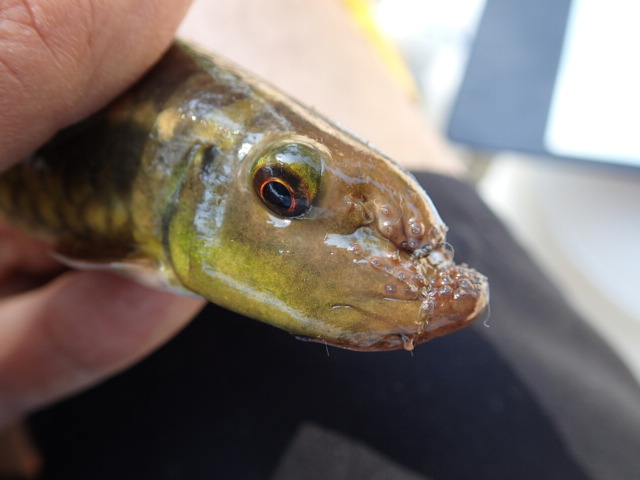
The mug of Garra fuliginosa
            I have been to Thailand before but was mostly in Bangkok and the island of Phuket targeting marine species. This time around we focused on tadpole-sized freshwater loaches that live under rocks in mostly shallow streams. This trip marked my 15th to Asia but each time feels new, this was Valencia and Pam's first trip across the Pacific and there would be lots of new sites, smells and sounds for them. Along with the balitorids we got other fishes that live in similar habitats like spiny eels (Mastacembelidae), catfishes (various families) and snakeheads (Channidae). Perhaps the oddest thing we got was Garra fuliginosa, a strange little minnow with a long proboscis covered in tooth-like tubercles. Some species in the U.S. have similar tubercles, like the fathead minnow (Pimephales), but nothing like the gnarly forehead these guys have. At each site we had Zach Randall (UF) taking excellent photographs for a book he and Dr. Page are publishing on the fishes of the region. We also had Brooke's lab filming videos of the loaches walking – and boy can they walk (see video below). Brooke’s lab had an amazing set up of glass boxes, electronics, batteries, Legos and even a Steve Irwin doll – all for the sake of science.  
            I was shocked at how much convergence there was with some North American stream fishes - there are look-a-likes of our darters, minnows and sunfishes that are in distantly related Asian families. I had to sometimes ask the UF crew - are you sure that isn't Cyprinella venusta the spot-tail shiner that is ubiquitous in Louisiana rivers? Ironically, the “Rule of Life” we are studying for our grant was evolutionary convergence, but not between American and Asian stream fishes - but between the first fishes that came onto land in the Devonian 400 million years ago (and gave rise to all land dwelling vertebrates  i.e., tetrapods like birds and other reptiles, amphibians, and mammals) and these walking loaches that are the only other fishes to have developed strong bony connections between the vertebral column and the pelvic girdle as a convergently remodeled "hip." Throughout the trip Brooke's lab would come up with "Silly fishes hips are for kids" type of puns, which a bad dad-joke teller like me eats up like sugary breakfast cereal.
            Although we spent many beautiful afternoons walking through shallow streams in absolutely perfect weather (it was sunny in the low to mid-80s) the highlight of the trip was certainly our very first site. The day after we landed in Bangkok we got onto another plane (one not much bigger than a puddle jumper), this one took us near the Myanmar border in Northern Thailand to the subterranean home of the cave angel, Cryptotora thamicola. This species is actually the one that inspired Pam to become a cavefish biologist before she started graduate school.

Pam (an expert caver) and me (not an expert caver, but one that delights in them) and I have been thinking about this site for months. Information on this cave and species is sparse and we were given conflicting information. Nevertheless, we were excited to get to the site. With Zach and a number of our Thai colleagues we spent more than five hours crawling, bouldering and slipping in Maelana Cave. It was a beautiful place with lots of gorgeous formations, most spectacular was perhaps the waterfall where Cryptotora live. Seeing these fish in their natural habitat is one of the most beautiful things I’ve ever seen, but I must admit hearing Pam gushing over seeing these fish that have been her muse for so many years was even better. We would see a number of individuals in the fast-flowing water where they were all concentrated, and although we could not see over the waterfall there are presumably more below. Zach took videos that we will use to study how they “walk” and swim. Later when watching the videos, we learned that GoPro will add sound to them automatically; the techo-trance beat for one of the videos became the soundtrack of the fieldtrip.
Our 10-day trip was a success and the UF, NJIT, and LSU teams are all now back safe stateside getting geared up to collect data for our NSF Grant. Stay tuned as we learn more.

NSF uRoL:FELS:RAISE: A Phylogenomically-Based Bioinspired Robotic Model Approach to Addressing the Evolution of Terrestrial Locomotion


Friday, September 13, 2019

(Finally) Collecting fishes in Haiti


In August (of 2019) my PhD student Diego Elias and I traveled to Haiti; a place I’ve been trying to collect from since my first fish expedition trip 15 years ago. Back in 2004 I was a PhD student, and I was in the Dominican Republic, the country on the other side of the island of Hispaniola. Back then I was greener than a Louisiana lawn in Spring, I learned a lot the hard way that first trip. Never-the-less it was a fruitful trip that taught me that there is no substitute for studying your research animals in the field. What I was studying then was a supposedly endemic Dominican cichlid species that was supposedly different from the one on the Haitian side. I would end up synonymizing those two species into one based on some additional Haitian samples that I was loaned, but I always regretted not having gone over the Central mountain range to the Haitian side. Haiti seemed close, but still very far, if not physically than culturally. The biggest barrier would be safety, I was told by my Dominican colleagues that we would need to rent a helicopter and have armed guards to collect on the other side. I didn’t know it would take me 15 years to get to the western side of Hispaniola and that very little of what I heard about this country would turn out to be true.

We shall not cease from exploration
And the end of all our exploring
Will be to arrive where we started
And know the place for the first time
-T.S. Eliot
           
This trip was part of the last leg of my National Science Foundation grant ‘Not So Fast: Historical biogeography of freshwater fishes in Central America and the Greater Antilles.” The freshwater fishes of Haiti are special; this country has one of the largest freshwater lakes in the Caribbean and some of the most unique fauna in the Neotropics. That largest freshwater lake, Lake Miragoâne, is said to have an endemic radiation of fishes in the genus Limia, a group of poecilids (also called mollies or livebearers because they have live young). Some have called this endemic radiation of Limia a miniature version of the famous cichlid radiation in the Rift Lakes of East Africa. For a country that is only 10,000 square miles, it has almost a dozen endemics; in contrast the entire island of Puerto Rico has zero endemic freshwater fishes. Another reason it is special is that Hispaniola is a composite island made up of several other islands smooshed together, we would spend much of our time on the “south Paleo island” around the capital Port-au-Prince which appears to have remained somewhat isolated from the other geological portions of the island.
Limia from Lake Miragoâne
            Unfortunately, despite all their freshwater, Haiti has no practicing ichthyologists. There are plenty of people working in agriculture and business and many people are living off their land. We are often presented with the narrative of how this country is the poorest in the West, but that is only if you measure wealth in GDP; many people here are far from poverty, they have nice homes, many goats, some farmland – they lack debt and many would be better off than most of us if we suddenly lost our jobs. Whenever Haiti is mentioned in the news of a Western website we are fed images of a downtrodden country with open sewers and earthquake- and hurricane-ravaged people. Civil unrest did thwart our attempts to travel there several times, as Haiti was under a Level 4: “Do Not Travel” State Department advisory for much of 2019. Finally heading over there in August (at a manageable Level 3: “Reconsider Travel”) I was expecting to be documenting extinction and counting all the introduced tilapia I would collect instead of natives. Instead what we found is a vibrant country with many pristine natural areas with remarkable, resilient and industrious people.
            We were hosted by Martin Reith a botanist working as the curator of the Jardin Botanique des Cayes. Martin is a German who grew up with a strong interest in aquarium fishes and was eager to help us. Dr. Debra Baker from Kansas put us in contact with her student, Wilnise Louise, who is doing her Master’s in agriculture in the north “Le Cap” part of the island. I did not want to collect in another country without locals so I insisted we bring a local student along, and I’m very glad we did – Wilnise was a wonderful contributor to our efforts. We also needed a driver and someone who knew the roads. Martin is relatively new to Haiti, having lived there for less than a year, although you wouldn’t know it from his impeccable Creole. He lived in the Dominican Republic in the five years previous to his move, so he did know the island, but he did not yet feel comfortable driving around Haiti. We hired a truck and a driver, Simain Dimmension, and he would also be an integral part of the “L’Equippe Poisson.”
L’Equippe Poisson
            Our trip did not start out well, we turned out of the airport and picked up some bottled waters that had the strong taste of salt. As we would be relying on bottled water during the trip, this saltiness was not a good sign. In most countries I visit I take my chances and drink the water from the tap if the locals do that – the locals in Haiti were all drinking bottled or bagged water. After getting our first taste of cold salt water, we turned right from the airport and were excited to be headed towards our first field site when we got stuck in traffic – for three hours!!! Apparently, the major road we needed to take was flooded; we were not moving at all and ultimately had to turn around and find a place in Port-au-Prince to stay. After a long day of travel (we had left Baton Rouge at 5am), the ‘Prestige’ beers and even the fried tilapia tasted great, although I grew concerned that we would see no other species of fish during our trip.
            Mercifully we were able to leave Port-au-Prince without incident the next morning. Our first destination was Lake Miragoâne, where I had dreamed of collecting for so long. After some minor sampling along the way we ended up at a little bathing area where people were drinking and partying around the huge lake. It appeared to be the only easily accessible entry for some distance. We were a curiosity to the crowd at first, and I am used to that, foreigners coming in with big fancy fishing nets often draw a crowd, but I noticed the space between the revelers and our crew was shrinking. We were doing our best to explain what we were doing to the people closest to us, but there were lots of people and not everyone got the full story. Most of the people around us were men and they were, let’s say - not at all sober.
            Despite there being bathers nearby we could see that there were lots of small fish in the water. A little secret about the cichlids and mollies is that they like dirty water, the additional nutrients from the soap and grime in the water is like junk food to them. The water wasn’t that dirty really, just with some added soapy nutrients, but we knew it would be a good site for collecting some of the endemics from this lake. We explained to a few people around us what we were doing and why, but word did not spread. We entered the water and the crowd around us closed in, the water was very muddy were we entered, which is why there were no bathers in that section. With Diego and I half submerged pulling a large seine the crowd descended and the mood changed quickly from a party atmosphere to more of a skeptical mob - people started picking out our fish and some were helping us put them into containers, others were yelling. Before I knew it four drunk guys were walking off with our seine. It was chaotic, people going in multiple directions with our gear, it turns out that some inebriated guys thought they were going to get paid for collecting fish for us. Although I’m happy to help people out there was no way I could start handing out bills in the mess that was going on. In the end we were able to get our gear back and hop back in our truck, but some of locals were not happy that we were leaving. A few of the men were demanding money ‘for their trouble’ – it was clear something had to be done. Diego passed them a bottle of rum and that did the trick. That was some quick thinking on his part, and it saved us from a rather sticky situation.
Our sampling sites in Haiti. (Created by Regina Champagne.)
            That event reminded me that we did look like an odd cast of characters, with our fancy nets and foreign faces - the locals should mistrust us. Who were we to collect their fish? Although we did explain to some of the people there, not enough of them were around us to hear. The rest were thinking we were coming in gangbusters doing some strange stuff in their water. I don’t blame anyone there for the misunderstanding, I’m just sorry that we didn’t have time to explain to everyone why we were there. We were there to document what of the local fish fauna remains so that we can help protect these freshwaters.
            We did get a nice collection of fish even from that one spot on Miragoâne. We ended up driving down the road a bit and finding a spot that seemed relatively quiet to process the fish, but even here we were quickly crowded by a group of a dozen or so people, but this time they were a curious and sober bunch, and I was able to use my limited French to explain what was happening. We also had Wilnise and Simain participating in processing the samples. What we were doing must have looked rather strange: taking parts of fish and putting them into small laboratory vials, then tagging fish with plastic labels. Diego had a photobox and was taking some really nice images, which the crowd took great interest in; these images are important because these tiny poecilids are very hard to tell apart. I took the opportunity to explain how to differentiate the introduced species from the natives to the locals. Tilapia, which has been here since the 1950s – introduced by the United Nations to increase protein availability – is not easy to distinguish from the native cichlid, Nandopsis haitiensis, and many locals did not know that tilapia was introduced from Africa. Likewise, the poecilids, which are not a food fish, was not a species most of the locals pay much attention to. It was a proud moment when I heard Wilnise explaining the scientific goals of our trip in Creole to the locals. This was the start of her training: I wanted her to become an expert on Haitian fishes in a country that lacked such an expert.
            We sampled in various parts of Lake Miragoâne over the next few days, driving around looking for areas we could conveniently, and somewhat quietly, enter. The lake is only 10 square miles but remarkably has seven endemic fish species, partly due to the variable habitat. On one memorable trip we went down to a spot where water taxi’s (wood or metal canoes) take people to different areas around the lake. The spot was actually between Lake Miragoâne proper and what was being called Petite Miragoâne, which were connected by a shallow waterway that must unite the lakes into one during periods of flooding. We went by canoe through a mass of thick reeds and water lilies, with jacanas, dragonflies and other wildlife. I was very happy; especially as the channel opened up to the bigger lake. The area was pristine and gorgeous; the big flat lake with dark green water was surrounded by lush mountains on all sides. We were catching plenty of the native Limia that we were after; unfortunately, we were also catching Asian carp that we did not expect to see. This species grows very fast and can reach 30 pounds making it easily the biggest freshwater fish in Haiti, these fish can also alter the environment by removing native vegetation.
             After Miragoâne we went west to Les Cayes where Martin lives and works as curator. Les Cayes is the world's largest supplier of vetiver, a fragrant bunch-grass from India that is used in perfumes, cosmetics and aromatherapy. You could smell the vetiver rather strongly as you entered the town. It was also interesting seeing breadfruit growing and being eaten. Having gone to Tahiti last year, where breadfruit originates, I couldn’t help to think of Captain’s Bligh whose men famously mutinied on his ship the HMS Bounty in 1789; the mission of that ship was to bring breadfruit to Haiti and other parts of the West Indies (there are five movie versions of ‘Mutiny of the Bounty’ the most famous one being with Marlon Brando).

Dormitator maculatus
            Les Cayes is in one of the most southern stretches of Haiti, and almost at its Western edge. In spots near the coastline I was reminded of Tahiti, with aqua blue waters and the surrounding mountains. But there is also an awful tide of sargassam drifting in from further out in the Atlantic that is currently sullying the coastline. Luckily, we were not after Caribbean fishes, we were focusing on freshwaters. In Les Cayes, we collected some sleepers (Eleotridae) and gobies that are associated with more brackish habitat. One of my favorites is the fat sleeper Dormitator maculatus that has a large bright blue spot behind the head – they look a bit ridiculous but they’ve managed a pretty wide range. We hope to one day look at the population genetics of this beast that can be found throughout a wide part of the Neotropics and supposedly as far north as North Carolina. We sampled in the lovely Botanical Gardens where we saw lots of amazing plants and saw white necked crows and other neat fauna. Although this site was lovely I couldn’t help but notice the many fishes we would see in the ditches around town, after ignoring them for a few days – it is always best to look away from the open sewers in the city center– I decided I would go down into one.


From five feet above I could see there was a good bit of fish diversity and I kept seeing some flashes of color I didn’t recognize. Throwing on a cheap pair of plastic waders and covering my mouth I dropped into the ditch with two dipnets and scooped up all the fish I could get while trying not to smell the poop smells I was kicking up. It was gross but it was worth it – we collected some species we didn’t get elsewhere and one – Poecilia reticulata, that is introduced and not yet fully documented in the scientific literature – it is also a species that I collected from a much cleaner ditch in Tahiti. I will be sending these to a colleague who studies this species for its endoparasites and population genetics. The ones from Haiti should have a lot, as we sampled the fish we noticed their guts were full of horrible smelling black ‘crap’ – most likely literal ‘crap.’ When you eat junk food you need a lot of it to get any nutrients. After I was done sampling I threw my waders into a garbage bag and we headed up to a mountain stream that was the complete opposite of that ditch site.
            The Mountain stream ‘Riviere Glace’ was perhaps the most beautiful of the trip. It was also a relief. The water was refreshingly cool, and as the weather had been hot and humid and we were sweaty and gross it was a wonderful relief to be submerged in the cool clean water. We were not the only people who noticed how lovely the water was, there were people working on the minerals and rocks from the surrounding mountains and these men with white powder covering their faces came down like ghosts into the water, it was startling at first but also fascinating to see them transform from these pale powdered sickly forms to their natural youthful state as they washed clean in the river. As Diego cast-netted I used a trusty dipnet along the rocky banks to catch a few small fish. I was not sure what they were but they looked a little different than the poecilids we had collected at lower elevations. These had a blueish tint, but they were not very big. Diego and I tried to pull a seine across the river but the bottom was so rocky that we had trouble, at the other side of the bank I told him just to hold it up against the banks with me and I asked a man who was sitting nearby to slowly walk towards us in a shallow pool. When he approached he scarred the fish that were in the pool into our net, we didn’t notice them until we pulled up the net and we saw there were easily 300 robust sized poecilids in it. We didn’t see that coming – and that’s the magic of seining – you never know what you’re gonna get. We took a portion of them, releasing the majority as they all appeared to be the same species – albeit a potentially new one. We collected many large ones and at that size you could really see the light blue coloration, these certainly appeared to be something we had not seen and not a species we knew about from the literature. It is perhaps new to science but stay tuned. The environment can cause morphological variation in populations that can trick you into thinking you have something new but it is just variation.
            In Les Cayes we stayed where Martin lived in a wonderful historic home where he rented a room. The house was a maze of artwork, including a lovely portrait of a women with a turkey on her head at the front entrance, later on the street I would see a women with a live turkey on her head in exactly the same fashion. The house was quite a relief as the hotel rooms we had been staying in had limited water access and often no electricity, it often felt like we were staying in hot dark concrete boxes. The old home also gave us access to some privacy where we could sample our fishes at night which is a nice privilege when you can actually take your time and have a good look at what you collected. When you need to prep the samples in the field it can be a bit rushed and you don’t get the images or a chance to look over the fresh specimens before their live colors begin to fade. Diego and I sometimes stayed up past midnight so that I could help him take better quality images of some of the fish using his photobox. I also noticed that he was being quite fastidious with the preparation of the specimens. Most of the fishes we were collecting were finger sized or smaller, so we stopped our old sampling method of tagging the fish with a tagging gun (the same one used to tag your clothes with price tags), instead we were using fishing line to more gently make a loop around the mouth and gills with a tissue tag number. This took more time but made for better specimens. In my 15th year of collecting fishes I was still learning things thanks to Diego and I was proud of his efforts and diligence. I had seen it before when we met five years ago in Guatemala where he is from, but now I saw how his skill set transferred over to his PhD work and it was nice to be able to see it all come together for him.
With some students from Université Providence d'Haiti

 We would end our ten-day trip staying at the Université Providence d'Haiti, a small new private college on the shores of Lake Azuéi in Ganthier. We were greeted with the loud chirping of African weaver birds and I was worried that the lake would be full of introduced fish too. This lake was notable to me because the eastern shore is in the Dominican Republic side, so you could cross the lake to get to that country. But this lake was 65 square miles so much bigger than Lake Miragoâne but the latter is strictly freshwater and this lake is considered brackish. We would get freshwater fish here but also things you would expect in the oceans like large needlefish. Fifteen years earlier I had been on the other side of the mountains in the Dominican side looking at the sister lake adjacent to this one called Lago Enriquillo. Side by side they sit with some of the most unique fauna in the Caribbean. Here there are crocodiles and flamingos, and it feels different than the rest of the areas we visited. The water is calm and flat and there is something about the white flat sands around it that always makes it seem a little hazy, a little more otherworldly. On the Dominican side I remember getting strange pupfish, and we were hoping to get some on this Haitian lake too - we did. These pupfish are resilient little things. They are members of the family Cyprinodontidae, that pop up in some odd places including Death Valley where some pupfish species are known from single localities that are smaller than your average college classroom (Devil’s Hole pupfish being the most famous), they are also known from some hypersaline locations. In Louisiana the Sheepshead minnow, Cyprinodon variegatus, is the most common pupfish we would encounter. They are called pupfish because of their tendency to wiggle like happy puppies. We would seine in the lake and surrounding region several times bringing with us local students to show them what we were doing. I also gave a lecture about our trip, and although my French is passable it was suggested that I have a student translate my talk in Creole. I had not realized until then how different the languages were, Creole is what most people spoke although much of the business and political matters were done in French. Unfortunately, that creates a bit of a class system and confusion too. I would learn a lot about Haiti from the students and profs at the school. Our understanding of this country is based on the trama of poverty, earthquakes and hurricanes but we forget that this country had a successful slave revolt 200 years ago that freed this country from the French, and even though Haiti paid the equivalent of billions to the French at the time, the French still claim this small island nation owes them debt.  That financial debt significantly handcuffs Haiti’s own independent economic success, as does the lack of support from other French speaking countries. But back to the fish.
Nandopsis haitiensis
            We would sample in and around the lake and we got massive cichlids here as well with the aid of some fisherman who were collecting in the interior portions of the lake. I had studied Nandopsis haitiensis and the other cichlids from Hispaniola and Cuba for my PhD dissertation, I even raised one of these from a thumb nailed size thing to a hand sized adult. We had been collecting smaller sized cichlids throughout our trip so getting big ones, about as big as they get even in aquariums, was amazing. Some males even had big fleshy humps on their heads when they were in a breeding phase. Upon seeing them Diego said ‘these are some proper specimens’ and they were. I was glad to see that the lake was still able to produce such healthy individuals and I told the students it was their duty to protect these waters and the fishes which they seemed keen to do. I also told them about the tilapia that we also found in large sizes in the lake and told them to eat those rather than the native Nandopsis. Diego and I are working with an undergrad now to put together a pamphlet and poster to send to the students we met there and to give to locals like Wilnise to train others. I still get messages from Wilnise showing me some fishes that she is continuing to collect - nothing could make me prouder. We plan to collaborate on a paper about our collections.
            There are so many things about Haiti that surprised and delighted me. I love the packs of kids that were roaming around and following us everywhere, even deep into the wilderness. They were growing up educated by nature as much as by books. At the same time the local knowledge of introduced versus native fishes was lower than I expected and it seemed as though tilapia was the most common fish on the plate and in the freshwaters. Marine species were given much more attention. I had expected to be documenting a freshwater disaster, with little habitat remaining for freshwater animals – instead Diego and I found a forgotten paradise that just lacks scientific infrastructure but certainly not human capacity. I can’t wait to help build that infrastructure as we send back the data and information about our collections to our new friends and colleagues.

Lake Azuéi 


Monday, September 3, 2018

Ichthyological Adventures in the Boiling River of Peru


August 2018 was my tenth anniversary at LSU, and I spent it in Peru. The Museum of Natural Science, where I am Curator of Fishes, almost always has someone in Peru; it often seems that there are more folks from the Museum in Peru than in Baton Rouge. It was finally my time to see what the fuss was all about.

I was invited to go to Peru, and specifically to the Boiling River, by Andrés Ruzo a PhD Candidate at Southern Methodist University in Dallas, he is also a Peruvian and a National Geographic Explorer. Andrés has written a book and given a TED talk on his discoveries from this important and unique river: I highly recommend them both. Andrés has an infectious energy and that is a large part of why I wanted to go on this trip. He and I talked at the TED conference this last April and he showed me pictures of some fishes that he had photographed from the Boiling River. He showed me a picture of what he called a “suckerfish,” I told him that the spikey-faced catfish in his picture was from the genus Ancistrus. We realized then that that I might actually be helpful if I brought some biological expertise to his geological mystery.

The region Andrés was targeting had not been previously sampled by any ichthyologist, in fact, before Andrés recognized the scientific importance of this area a few years ago, no scientists had collected in this area - period. Given its unique ecology and geology I thought the Boiling River would be an excellent opportunity to discover new species; particularly as it is part of the super diverse Amazon basin (home to more than 3000 fish species).

The Boiling River runs through a small Peruvian shamanic village called Mayantuyacu and has the traditional name Shanay-Timpishka (or ‘Boiled by the heat of the Sun’ River). It took a plane ride from Lima to Pucallpa and then another few hours of off road driving in Toyota Hiluxes to get to the remote village. As we approached the village you started feeling a strange heat and could see steam rising above the tree tops well before you laid eyes on the river.

As you would guess this river gets very hot, so much so that there are no fishes in the areas that get the hottest. (Notably, Andrés has found some interesting non-vertebrate extremophiles living in the hottest sections.) So why would an ichthyologist go where there are no fishes? Well, the hottest sections are very hot, but it wasn’t continuously hot throughout the river; so, I was curious how fishes got into the areas that are cooler, between geothermal pockets. Also, I wondered if there were fishes trapped in cooler pools of water adjacent to the main river.

According to Andrés the Boiling River is the world´s largest known thermal river, flowing hot for 6.24 km (of the 9km system) and reaching max widths and depths of 25 meters and 4.5 meters. It is also uniquely the only thermal river that is non-volcanic (the nearest volcano is over 700 kilometers away). Besides the geological work Andrés was also there to raise awareness about the destruction happening to the surrounding region, which was losing rainforest at a rate of about half a soccer field a minute. Andrés’s field team included his father, other folks from National Geographic, schoolteachers, students, a social media guru and a chaperone. If you think that sounds like a pretty novice crew let me tell you they were not. The two high school students in particular, both 17 were absolutely brilliant – one was an excellent drone flyer, GIS guru and mapper (McClain Martensen) and the other (Kyle Smith) earned more than his keep with his card tricks and water quality testers (that he engineered himself - including the welding and programming). I was flabbergasted that Andrés’s team was able to 3D model the region based on the drone and water data, all while we were still in the field. I was also amazed at how everyone got along so easily. Even after long days of hiking and bruising climbs everyone stayed cheerful despite sometimes less than agreeable conditions (bugs, heat, lost drones, no electricity, etc.).

 Our accommodations were in a little village famous for its use of medicinal plants. We had no electricity most of the day and the food was purposefully bland as many people were avoiding salt, caffeine and other foods that might interfere with the medicines. The water we drank came straight from the river, and I would wake up each morning and bring a cup and tea bag straight to the river each morning. It was unbelievable how hot the water was – especially given how fast it flowed. The amount of energy needed to heat that much water that quickly must be absolutely massive. The steam coming off the river produced a lovely ghostly cover around us, at times it was indescribable dense, a thick warm fog that could obscure the fingers in front of your face. My first field site was a bit downstream from the hottest  part of the river itself – I knew there were no fish there, but recording the absence of fish in my fieldnotes could be a valuable data point in the future. Perhaps if the oil companies in the adjacent region, or even the Peruvian government have their way, this area may be flooded by damning or other anthropogenic influences. Perhaps then the Boiling River will have fish in it, and I wanted to be able to say I sampled it before any of that happened – hoping it never does. Throwing a castnet into the waters I had to be very careful not to have it snag; going into the water to untangle a net in near-boiling temperatures was not going to happen. As I pulled it back out of the water, predictably empty, some water splashed on my leg and it stung for the rest of the day. Walking along the river, sometimes over wet rocks at night, we had to be weary of the river’s power - falling in could mean severe burns, or worse.
           
We sampled each day in different parts of the river, moving upstream as far as we could go, which also meant a great deal of hiking. Much of my catch was in dipnets (small handheld nets) and castnets, as much of the collecting had to be done adjacent to the river in little pools of water, rather than the Boiling River itself. I also collected along the Pachitea, the major drainage near by. Which besides the Boiling River also led to the mouth of the ‘Salt River’ (which had high salt content despite being far from the ocean) and the ‘Hot River’ (which was warm, but far cooler than the Boiling River).

            I was upset when I woke up early one morning to hear rain - a tremendous amount of rain. I had hoped to have had a full day of collecting, but I knew the four inches of rain we would ultimately get that day would prevent that from happening. One notable thing I discovered was that the rain had made the Boiling River much more hospitable – so much so that you could swim in it, and we did. The river, instead of being the clear steamy steady stream it usually was had become a Willy Wonka-esque muddy hot chocolate stream with an incredibly fast flow; far too fast to throw a net into. On that rainy morning I felt like we were given a one-day pass to experience the river without its power – I also feared that this chocolate version of the river might be the future if damming and river diversions upstream every happened. I also thought: ‘so this was obviously how fishes and other animals could get upstream to cooler areas of the river.’ Mystery solved – sort of. Despite the fast flow, the fishes I saw in the previous days could likely move upstream in those conditions. What remains unclear is how they would get above some of the more physically complex areas that are only accessible by going up waterfalls and up vertical cliffs.

Bujurquina
            One notable catch was a small fish in the genus Rivulus that I caught serendipitously. I found it only after one of the members of the team slipped and fell into a little puddle of water between some rocks high above the river. I stuck my dipnet in the puddle and found this little fish. I was unable to ID it to species, so it may represent something new. After the rains, I went back to the same locality and found that the water trickled down from rocks above which I climbed. There was a steady flow of water from an area that seemed independent of the Boiling River (now named the Sheripiari´s – N – Creek by Andrés), and because of the additional rain the pools up the rocks were now connected by a small cascade of water. I collected two more specimens of the Rivulus. Even further upstream as far as we could go is a large pool of water where we collected more catfishes but also beautiful cichlids in the genus Bujurquina – I was very surprised to see these cichlids so high up the path. These cichlids attach their eggs to loose leaves that are then guarded by both parents; once the eggs develop a bit more they are taken into the parents’ mouths for further development. These fish most likely got here during the rainy season, when more of this area is flooded, and the water cooler.

I left the Boiling River with more questions than answers. We also left on foot, because even the mighty Hiluxes could not go up the now muddied post-rain paths. The path back to the main Pachitea River was one that I dreaded as we had walked it several times. In full sunlight with all your field gear (including a bucket of dead fish in formalin) it was not the easiest exit, in fact it had been one of the hardest walks I’ve ever done (particularly the time when returning from a full day of collecting we had all run out of water and were utterly dehydrated). Never-the-less I knew if the village wasn’t so remote the fishes probably wouldn’t be that interesting. Being remote protected this land, but it grows less and less remote each day. From when Andrés first started coming here to today the surrounding forests are being decimated for logging and for other commercial interests. We saw and heard illegal logging, and with ‘economic progress’ the river will become less and less protected. I know that unlike our team, who had asked the Shaman permission to collect and study the river, others might not be so willing to seek approval from the local indigenous people. I hope to see the Boiling River again one day, to feel its strange heat, and to study its mysterious fishes once more. I hope on my return others will have learned from Andrés and others just how special this area is, and how worthy it is of preservation and protection.

Sunday, November 5, 2017

In the South Pacific for some Ichthyology


In late September my PhD student Bill Ludt and I traveled to the beautiful island of Tahiti to attend the 10th Indo Pacific Fish Conference. This meeting takes place every four years and I have been anticipating this trip since Bill and I went to the last meeting in Okinawa in 2013. I also knew that I couldn’t go all this way not to collect fishes. As with other conferences in remote locales, and most field trips, it took a while to get permits; we were lucky to get them a day before our planned travel began (even though Bill had been working on them for more than a year).

Also joining us for part of the trip was LSU Biology professor Brant Faircloth. Brant and I submitted a proposal to run a symposium on fish systematics focusing on ultraconserved elements. Our session ultimately became part of a half day symposium called ‘Genes to Genomes: Forging ahead in the study of marine evolution” which we were happy to help organize. (Special thanks to Dr. Michelle Gaither who was the lead organizer and did all the heavy lifting.)

Soon after arriving we knew we were in paradise - an expensive French paradise. My French is passable, but most of the locals we met also spoke English as well their local Polynesian dialects. I always wanted to come to Tahiti, not so much for its fishes or the beautiful teal-colored water, but because I loved the history of Captains Cook and Bligh in this region; and because of films like Marlon Brando’s Mutiny on the Bounty.

We went to the central fish market in Papeete around 5am the first few mornings to see what we could get. We made nice collections of local wrasses, goatfish, and unicornfish among other colorful, if odd-looking, species. At the local grocery store we did come across a large specimen of an Opah, or “Moonfish” which gained some notoriety recently as being “warm blooded” – although some ichthyologists remain unconvinced. Sadly the specimen was too big to collect, and already had it’s gills removed.

Opah at market (left), butterflyfish (top), and unicornfish.
We also traveled to the island of Moorea, which is about a 45min ferry ride from Tahiti. This island is home to, among other things, the Gump Research Station run by UC Berkeley. The Gump helped us get our permits but we were unfortunately unable to collect on Moorea. We had to settle for a lovely day snorkeling in crystal clear water surrounded by lush green mountains.

The conference started a few days after our arrival, and it had about 500 attendees from around the world. Bill, Brant and I all spoke in the first session of the first day after the plenaries. The Indo Pacific Fish Conference is one of my favorites because I get to see many of the European, Asian and African colleagues I often don’t see at conferences in North or South America. Bill and I started several important collaborations that hopefully will make for some fruitful publications over the next few months and years.

Bill, Brant and I in Cook Bay, Moorea; Bill on stage presenting his talk.
Although we didn’t hit the markets again during the meeting, I did get to collect some introduced guppies. The extent of my freshwater fieldwork was putting a bag down into a sewer off the main road in Tahiti and letting it fill with water then pulling the bag out of the water to find that 50 individual guppies had swam into the bag. Many of these specimens were mailed off to a colleague studying the introduction of guppies around the world. He was very happy to get individuals from this distant and isolated population.

            I’ll spare you more details about the fish conference and swimming with humpbacks (as I did) and tiger sharks (as Bill did) and such, but rest assured this was no vacation (although it obviously wasn’t all work either). The conference was a great opportunity to talk about our work, including one collaboration that recently yielded the cover of Systematic Biology (Chakrabarty & Faircloth et al. 2017; left). That publication created some great opportunities to work with other scientists interested in using genomic fragments like ultraconserved elements in their phylogenetic studies of fishes.