Tuesday, July 9, 2013

Ichthyology trip to Japan: Conference Piggybacking


At the end of June, my PhD student Bill Ludt and I went to Okinawa for the 9th Indo-Pacific Fish Conference (IPFC), and then traveled to Tokyo to do a market survey and collection at the famous Tsukiji Market. The IPFC is held every 4 years and it is a mix of an ichthyology and evolution conferences that is important for everyone working on fishes in the region. This year’s conference was particularly important for me because it included a Percomorph Symposium that dealt with higher-level fish systematics and included a series of well-known and well-respected speakers (obviously I wasn’t invited to speak), and it was one of the most important single days in systematic ichthyology signaling in a paradigm shift in our discipline.
Bill Ludt:Tuna Hunter
        The meeting is typically held in an interesting and beautiful location that is usually a great spot for collecting fishes too. The last IPFC in 2009 was in Perth, Australia; at that meeting I was able to get away to collect cavefish from Exmouth in the northern part of the country. This year’s conference was relatively small, with only 500 people, but it is a great conference for networking with other like-minded scientists. Both Bill and I left with several new collaborations that we are truly excited about.
Okinawa is at the southern reaches of Japan, closer to Taipei, Taiwan than to Tokyo and with a rich history of its own. (It may be fighting for its independence as a sovereign nation in the near future.) The conference center was a few steps from a beach and a crystal clear blue ocean, but there was little time to enjoy it. The talks were fantastic and groundbreaking with lots of new systematic efforts highlighting new molecular techniques. The next generation of sequencing is here and I was very excited to talk about ultraconserved elements and our project on using massively parallel sequencing to resolve the basal relationships of Ostariophysi (a group of 10,000 species that includes catfishes, electric knifefishes, tetras, piranhas, goldfish, and over 70% of freshwater fishes; this lineage alone represents 1 in every 6 species of vertebrate). After a few years of giving talks about projects I had just recently published I loved talking about something so fresh that I didn’t have results to talk about until a week before we were set to leave. Bill on the other hand was much better prepared and he gave an excellent talk on Prionurus, a group of surgeonfishes (so named because of razor sharp barbs near their tail). This genus of seven species are distributed in cold waters in disjunct areas that are essentially anti-tropical. Bill presented a dated phylogeny that helped explain their evolutionary history and unusual distribution. Directly following his talk several very well known scientists approached him and I was proud of him as he began making a name for himself in the fish world.
Tsukiji Market.
Bluefin tuna auction.
After the conference Bill and I flew up to Tokyo, which was another world all together. As a New York City kid that thinks he is well traveled (Japan was my 24th country visited) I was surprised by how mesmerized I was by this ultramodern city that still had plenty of old world charm. The largest city in the world humbled me in its size, diversity and culture. Along with exploring a new city, our main goal was to collect as many species as we could at the world’s largest fish market, Tsukiji. This is home of the world famous bluefin tuna auction where last year a single individual sold for 1.7 million dollars. The bluefin is highly endangered and could go extinct by the next decade or so. Sought after for its crimson meat that is a result of a countercurrent circulation that endows this great species with the ability to travel at amazing speeds also has made it one of the most sought after national resources in the world. Bluefin are flown in from around the world and I’ve actually seen individuals collected in Sri Lanka that would quickly make their way to Tokyo via private jet. Bill and I couldn’t resist heading to the market at 3am to observe the proceedings. The auction doesn’t take place until 5am but in order to get in to see the trading of bluefin you need to be ahead of the pack. The auction itself is rather quaint despite the high stakes: gentlemen (I saw no female participants) with flashlights and dower faces looked closely at the exposed red meat of the tunas like a mechanic evaluating the engine of a Lamborghini. The huge fish sold quickly and we were ushered away just as fast. Tsukiji itself was a bit of a disappointment to me. As the world’s largest fish market I was expecting to find a large assortment of species that boatmen were delivering directly to the wholesalers. In large markets in Thailand and Taiwan I saw enormous ships bring in thousands (if not millions) of fish to the banks and saw sellers buying up what they could: what they didn’t want was discarded in large piles. These large piles hide an exceptionally diverse assortment of rare species and often included deep-sea creatures that would be very difficult to get otherwise. Deep-sea research vessels can charge upwards of $30K a day, but at the bycatch trash piles the fish are free and the hard work is done for you. Unfortunately, Tsukiji is a different monster all together. The market is only open to the public from 9-10am. The rest of the time from 5am, the wholesalers are packing up specimens that are being brought in from all over the world and setting them up to be shipped out to other locations around the world. It is more of a post office sorting center than the all-purpose warehouse I expected. So that meant I found no bycatch pile and only fish that are being eating and sold for a profit. Many of the vendors’ booths, and there were over 100 of them, would not sell to us because they only sold 10kg at a time or some other fixed weight. We had a bit more luck when we explained we were scientists but because we came when the annoying tourists were also there we got many strange looks and curt replies when we inquired about purchasing the different species. In the end we only ended up with about 30 species and perhaps 50 individuals. However, since most of them are new to our collection it was certainly worth it. It just wasn’t what we expected from what we had heard about the market in the past.
Processing fish in the middle of a crowded Tokyo street.
Overall it was a memorable and productive trip both in terms of collaborations made and fishes collected. I most certainly want to return to Japan to do some proper collecting in the future.

Friday, March 22, 2013

Ichthyological Adventures in Central America Part 2: Collecting Fishes in Guatemala

Caleb at some Mayan ruins in Yaxhá.
           From February 28th to March 12th my 3rd yr PhD student Caleb McMahan and I traveled to Guatemala to collect and study fishes for the museum. This trip was particularly exciting because we had worked on obtaining permits from Guatemala for over three years. It was only through the networking of Caleb and my former postdoc Dr. Wilfredo Matamoros at the Congreso Nacional de Ictiología conference in Chiapas, Mexico (2012) that we were able to finally get some contacts that could help us. The trip was also very exciting for me because with these collections it meant that my lab had been to every Central American country. We’ve sampled Costa Rica (2011), El Salvador (2011), Panama (2011), Nicaragua (2011) and Honduras (4 times since 2010). I traveled to Belize as part of my dissertation work in 2004. Guatemala would be a real prize because no outside ichthyologists have intensively sampled the native freshwater fishes since Donn Rosen and Reeve Bailey in 1974. Both of those gentlemen are my heroes. Rosen was a former curator at the American Museum of Natural History and was instrumental in founding the field of historical biogeography. Bailey was a curator of fishes at the University of Michigan Museum of Zoology and was collecting into his mid 90s while I was a there as a grad student (he passed away at age 100 a few years ago).
The Guatemala Fishing Team, from left to right, Diego Elias, Yasmin Quintana,
Prosanta Chakrabarty, Caleb McMahan and Christian Barrientos.
            In Guatemala, we were aided by Christian Barrientos who is currently a PhD student at the University of Florida and a Guatemalan native. A-soon-to-be finished undergraduate, Diego Elias, and a Guatemalan environmental agent, Yasmin Quintana, also joined us to complete the collecting team.
Thorichthys pasionis
            Guatemala has a notable geological history as well as a biological one. The northern portion of the country is part of the Yucatan Peninsula (the Maya Block that is the southern portion of geologic North America) that is primarily in southern Mexico and parts of Belize. The more southern portion of the country is part of the Chortis Block that includes El Salvador, Honduras and parts of Nicaragua; this block is geologically on the Caribbean tectonic plate. The North American and Caribbean plates are separated by the Motagua fault that runs through Guatemala. You can see the difference as you drive along the central highway passing from the mountainous, limestone-rich Yucatan to the flatter more earthy Chortis Block.  We spent most of our time sampling within the Yucatan portion (Peten) where cenotes, caves and other primary limestone habitats were abundant. The karstic landscape gives a notable blue green tint to much of the freshwaters in the Yucatan region so that you could get fooled into thinking you are collecting in the tropical ocean if were not for the fact that you were surrounded by lush green inland forests.
Early morning casting in Lago de Peten.
            We began our trip, as we often do, landing in the capital city airport, Guatemala City in this case – and, as is typically the case – site seeing was restricted to what could be viewed from the car window on the way out to the countryside.  Luckily, the rich Mayan history of Guatemala has left much behind and we even sampled in the shadows of some giant ruins in Yaxhá (where the reality show Survivor was filmed in 2005). The perpetual frightening growl of the otherwise adorable Howler monkey also seemed to add to the sense that we were in a mythical, prehistoric land. Among our primary targets were the cichlid fishes of the region - about 23 species. Many of these are very important to our continued studies of Central American fishes and their biogeographic history. We sampled first along the Caribbean Slope in Lago Izabal, waking each morning before dawn and sampling until dusk. It was exhausting but well worth it. We typically collected from a boat that took us along to various sites that were otherwise inaccessible by foot. Using castnets and seines we collected the black-belt cichlid, Vieja maculicauda and several other beautiful species of cichlids I had only seen as colorless specimens in jars or from aquarist photos. One of the species we were collecting was Paraneetroplus melanurus that Caleb had studied and synonymized with another popular species (i.e., he found that the two species were in fact just one - much to the chagrin of the cichlid aquarists).
A nice "blanco"
            One of my favorite sites was Lago de Peten. Ever since I started working with cichlids as a graduate student I always wanted to catch “blancos,” Petenia splendida from Lake Peten. Not only did we collect them, we had enough to eat (it’s always good when your study animal is as delicious as it is phylogenetically important). Our local hosts are doing several ecological studies on the fishes in these lakes and they were surprised to see us catch several species they had not seen before in that area. I told them that it was all based on Caleb’s fishing skills. Caleb has quickly become one of the best-known ichthyologists studying Central America. He worked there for his Master’s degree at Southeastern Louisiana University but his reputation has grown greatly in the past few years, and deservedly so. I would put his knowledge of the fishes of these regions up against anyone alive today. He was recently rewarded for his efforts in studying the region with a National Science Foundation Doctoral Dissertation Grant. Caleb also won the prestigious Stoye Award at the Annual Meeting of Ichthyologists and Herpetologists, this award is the highest prize a fish student can get as a graduate student.
Mouth of the Coban, flowing out of a cave.
            One of our last field sites was in Coban, an area we were eager to sample because it is a very different system than the Río Usumacinta system we had sampled most of the trip. Unfortunately, our first Coban site smelled like a sewer. After retrieving my first castnet throw all I managed to pull out of the water was some weird white filmy material. As a faux-Cajan I cast by putting one end of the net in my teeth: this technique has its drawbacks. Just as I put the cast in my teeth for the next throw I was informed that the white filmy material was toilet paper: a clear sign that this water was full of untreated sewage. After washing my mouth out thoroughly we decided to move on. Luckily we were able to get much better sites downstream where gringo tourists were happily inner tubing. Some of our best collections were actually from local kids that were snorkeling and spearing the fish with makeshift spear guns. I envied their skill and was glad they happily exchanged their haul for a few quetzales (the local currency, named after the national bird - a type of trogon).
Caleb and Prosanta and their makeshift back-of-the-truck fish laboratory.
            Overall the trip was a success. We collected over 59 species, nearly 600 tissue samples and about 2000 specimens. There is much of Guatemala left unexplored because permission has to be granted by local native communities who can be weary of outsiders (which include local non-native peoples). Despite my desire to go to those areas I’m glad they are protected by people who care about their land and freshwaters. Yasmin and Diego are set to work up our collection at LSU in May and we look forward to figuring out if we have any new species. We most certainly made collections that other Neotropical ichthyologists will be quite envious of.  

Thursday, January 10, 2013

Collecting Fishes for a Biodiversity Workshop in Singapore


PC and Bill Ludt in Singapore
From October 15th to November 2nd last year my PhD student Bill Ludt and I traveled to be part of the Singapore Jahore Strait Marine Biodiversity Workshop. I had traveled to Singapore in 2007 to collect but mainly spent all my time at markets where I purchased fish that were being sold. (Market collecting can barely be considered fieldwork, the fish are brought to you after all; however, it is an excellent way to get a lot of diversity quickly and cheaply.) In my previous trip to Singapore I had assumed that this tiny island nation was essentially a giant city with little wildlife or remaining forest. That is why I was pleasantly surprised when I discovered that the workshop would take place on Pulau Ubin, a small island off the northern coast of “mainland” Singapore. Pulau Ubin is almost completely forested except for a few residents, bike paths for ecotourists, and an OBS (Outward Bound School) camp where we stayed most of the time.  The island is only 10sq km (about an 1/6 the size of Manhattan) but it is so densely forested that it sustains a large wild boar population that we saw frequently.
Fig 1: Anchovy, Coilia
This small island is also the location of the last reported tiger sighting (in the 1980s) on Singapore. (A tiger was famously shot under the Long Bar at the Raffles Hotel in 1902, that bar is also the birthplace of the notorious cocktail, the Singapore Sling.) We also saw wild otters a myriad of colorful birds (including an elusive Great Billed Heron), and of course, lots of cool fish. However, unlike my last Singapore trip we collected most of these fish ourselves and ended up collecting nearly 2,000 specimens from 250 species. We collected mostly using 15’ beach seines, but also using dipnets in mangroves, gillnets, and via trawls on a small ocean research vessel.
Fig 2. Stonefish
            This was a different experience than my previous collecting trips. I was invited to collect as the “fish expert” along with international experts in other groups including, bryozoans, anemones, isopods, copepods, etc. In all there were about 20 invited zoologists and dozens of local scientists and volunteers from the Raffles Museum and other local institutions. Each day we would sign up for one of three or four field trips to various parts of the island or mainland. Then we would go on a well-organized trip to that locality and collect alongside other experts for several hours before being returned to the lab at the OBS camp to sort, ID, photograph, tag and tissue the specimens. Bill and I would not only deal with the samples that we collected but also fishes that others collected for us. In the end we ended up having specimens from over 60 field sites in the nearly three weeks we were there.
            The OBS camp was an interesting place. Breakfast, lunch and dinner were served there in a regular schedule and in a regular pattern that we quickly grew tired of. The food wasn’t awful but we knew that just over the Serangoon Harbor there was the most delicious food in the world. Mainland Singapore has its own unique cuisine but also serves food from all over Asia. Bill and I savored each Roti Chennai, Chai Tea, and Chili Crab that we could get our hands on.
Fig 3
            In the end the trip was a wonderful success. We collected many species that were new to our LSU collections and that are rare in collections outside of Asia. Among the highlights is a specimen of Coilia, a bioluminescent anchovy (Fig1), a highly venomous and dangerous stonefish (Fig2) and several species of archerfishes (Fig3). The archerfish samples were particularly important. These fish hang out near the surface of the water and spit out a small squirt of water at leaves above them to make insects attached to those leaves fall into the water below. The fish then eat those insects. This unique behavior would make you think they are closely tied to the land but they have a rather wide distribution across several continents. My former labmate at the University of Michigan, Heok Hee Ng, who now works in Singapore and I will be working up the phylogeny of this group in the future.
            Besides establishing this collaboration and meeting many international experts this was also Bill’s first international field trip. He did an excellent job and he and I will be collecting again in Japan this summer. We can only hope that these future trips will be equally successful.


Friday, September 14, 2012

Going Down Under: Caving for Fish in Australia


November 2009

         In May and part of June, I traveled to Western Australia for a three-week trip that was equal parts collecting, museum work, and fish conference. For this trip I had to go down under, literally. The first part of the trip involved entering some tight subterranean habitats in search of blind cave fish. The second part of the trip was working up some bioluminescent fishes collected for me at the Western Australia Museum in Perth and the third leg was the Indo-Pacific Fish Conference in Freemantle. It was a very interesting and worthwhile adventure all around. This trip was also notable at a personal level because I was able to have my wife, Annemarie Noël, join me. I’ll spare you the details about the conference (I won an award!) and museum work (I found a new species!) so that I can focus on the collecting.
         The collecting trip was nearly derailed before it got started. Despite more than six months of planning and negotiation, my permits were nullified at the last minute. The permits were voided because of a miscommunication between the Western Australia Museum (WAM) and the Australian government. The timing could not have been worse; I got the news via e-mail the Friday before I was to leave. Because our Friday morning is already Saturday in Australia, I was unable to remedy the situation before my flights. I spent the entire time traveling to Australia worried sick that I wouldn’t be able to collect. After flying for what seemed like three days (actually only two days) and finally arriving in Perth I immediately called the collection manager of the WAM. She explained that there was a terrible misunderstanding and that she would talk to the government to reinstate my permit. Unfortunately the new permits were much more limiting than the originals, but certainly better than nothing.
         The next morning Annemarie and I boarded a flight to Exmouth, which is about 1300km north of Perth. The town of Exmouth is in the Northwest Cape, a small peninsula that is nearly the most western tip of Australia. Around that peninsula, also called Ningaloo, is the only part of Australia with cave fish. Their habitat is distributed around the few hundred kilometers of the peninsula. Only one species is known, Milyeringa veritas, commonly known as the blind gudgeon. Based on some preliminary work I suspect that there is more than one species. These fish are poorly known and the populations are likely much bigger than the few specimens we find in caves. Their real homes are the inaccessible underground water chambers that span many kilometers.
I became interested in blind subterranean fishes after collecting them in parts of Madagascar last year. The first thing I noticed about the Northwest Cape of Australia is how much it resembles Southeastern Madagascar. Both locations are dry landscapes with a bright maroon colored soil, baobab trees and short stubby brush. The other thing they have in common is the presence of blind, pigment-less, subterranean fishes. From my previous work I learned that the closest relative of the blind fishes in Madagascar are the blind fish in Australia. These helpless blind aquatic animals can’t travel 10 feet out of the caves let alone across the Indian Ocean. Their long history of living underground and being isolated from predators made pigment and vision unnecessary. The only explanation for the disjunct distribution of this Malagasy/Australian lineage is that these fishes were once part of a continuous landmass that subsequently broke apart. That former continuous landmass is known as Gondwana, and it included both Australia and Madagascar and possibly the common ancestor of these fishes. These fishes are part of a lineage that has survived the 130 million years since the break up of Gondwana. They’ve managed to survive in isolation oblivious to the changes above ground. The extinction of non- avian dinosaurs, bolide strikes, climate change, and the rise of humanity has not caused them to blink an eye (if they had eyes to blink).
On our first collecting day, we went to six locations where Milyeringa had been collected previously. At our first site, Woburi Rockhole, we drove a little bit off the road in Exmouth to a small hole in the ground that led to a larger underground chamber. We had to shimmie down a metal pole that was rigged up for cave divers to enter from above into the water below.
         As we entered you could see fossil marine shells in the limestone deposits lining the walls of the entrance. Inside the cave, which was tiny compared to what I experienced in Madagascar, we saw eight specimens of Milyeringa veritas. I was glad to have Annemarie with me as this was her first experience with caves. Inside the cave we found the skeleton of a large kangaroo that must have fallen into the cave about a month earlier. We were lucky we didn’t discover it a week earlier because it was surrounded by thousands of fresh fly egg casings. It will make for a fine fossil one day. We spent about a half an hour in the cave before moving on. The next sites were mostly wells that were built next to small enclosed caves. Aboriginals had used the caves to get ground water for hundreds of years and you could still see the shards on the ground from the shells they once used to bring up water. Later settlers built wells for easier access to the water. I shimmied down some of the wells by pressing my back and hands against the wall while my feet were pressed against the other side. In other wells our guide, the wonderful spelunker Darren Brooks, used repelling equipment to drop sometimes more than 30 feet to get to the water and fish below.
         The most interesting cave was a site we entered on the second day. At first glance I thought it would be impossible to enter. The entrance was just two small holes, one that looked to be about 45 inches around and the other perhaps 15 inches around. Neither looked particularly inviting. The larger opening and the tunnel below were so tight that I needed to take my helmet off in order to fit. The cave itself was shaped like an Erlenmeyer flask with a tight elbow shaped entrance. After dropping a small chain ladder down the hole (making the entrance even tighter) we slowly slipped down about 15 feet into a small pocket that led to a short horizontal shelf that led to another drop of 15 feet into the main chamber. This chamber was filled with water and luckily a couple of blind gudgeon. We needed the ladder for the last drop because there was nothing to grab onto for the last ten feet. The bowl shaped chamber was dark and damp and the high CO2 levels meant that we couldn’t stay there very long. We collected a single specimen from that cave and headed back out. The climb back out of that cave was one of the scariest most physically challenging things I’ve ever done. After climbing out of the first chamber relatively easy I made a stupid mistake and tried to exit by climbing out facing a different direction than I had gone in. I found myself stuck like a fly in a pitcher plant.
I could feel the cool air above me but I couldn’t move my arms above my head nor could I move my knees to leverage myself upward. It was extremely claustrophobic and terribly frustrating. After doing the equivalent of a hundred push ups and making no progress in getting out I headed back down to turn around. Finally, after 15 minutes of scraping myself against limestone and brushing biting ants from my face, I got out. All for a little blind fish – but in the end it was worth it. (My wife took excruciating video of my progress out of the cave that nobody reading this will ever see.)
The collecting part of the trip was much shorter than I had hoped but I gained enough materials to do what I had intended. Before heading to Perth Annemarie and I decided to do something completely different from hunting little three-inch fish in holes. We went swimming with the largest fish, the whale sharks. After dealing with dark and tight spaces it was great to actually get into the great Indian Ocean and follow some 20 foot sharks around for a day. The remainder of the trip was also fruitful and enlightening but nothing will be as memorable as our time in the Northwest Cape.

Collecting Fishes in Vietnam

 
by Prosanta Chakrabarty and Matt Davis

May 2010

In late January to early February of this year, my postdoc Matt Davis and I traveled to Vietnam to collect some marine fishes from markets. Every year I try to make a trip to Asia to collect rare fishes for the LSU fish collection and for phylogenetic study. The large open markets of Asia allow us to collect a diverse number of species in a relatively short amount of time. Instead of hiring a trawler (upwards of $10K a day) it’s easier to hang out on the docks to grab some freebies off the boats. Typically we collect early in the morning and spend the rest of the day processing the fish (voucher, label, tissue sample, preserve, etc.). Because of the great quantity of fish that we were dealing with it really did take nearly the entire day to process the specimens from each morning’s haul. On this trip we collected roughly 400 different marine species and more than 2,000 specimens in two weeks. We also had a couple of days to do some fresh/ brackish water collecting on the Mekong Delta. The Mekong is one of the world’s oldest and oddest rivers and is home to car-sized catfish, giant stingrays, and other behemoths of the fish world.
         Vietnam is a long narrow country that spans several biotic regions including the Mekong Delta, South China Sea, and Gulf of Thailand. We saw long stretches of amazing beaches, and miles of huge inland sand dunes directly abutting verdant green rainforest. It is also culturally diverse. We saw signs of socialist pride (the old Soviet hammer and sickle was ubiquitous) and French imperialism (baguettes and wrought iron abound), mixed with an Indo-Thai- Chinese culture found nowhere else. The people were extremely courteous and amiable, sometimes too much so, making for a fun cultural experience. Matt in particular was gawked at constantly for being a giant white man with funny colored straight hair.
         Matt and I traveled with four Taiwanese colleagues that had previous experience collecting in Vietnam. It was my first time traveling in Asia without locals to help translate (as the Taiwanese spoke no Vietnamese). This made for some funny and frustrating situations.
         During our trip we traveled to Ho Chi Minh City (Saigon), and the beautiful beach towns of Mui Ne and Nha Trang. The first two things that stood out about Ho Chi Minh City included the amazing diversity of food and the incredible numbers of scooters – the many, many scooters. These scooters zoomed past and parted around you like a school of fish. For the most part there were no traffic signals or even traffic patterns, just a free for all of scooters, taxis, and buses. Many large cities in Asia have similar numbers of scooters on the streets, but they all had some semblance of organization. Our Taiwanese colleagues, who ride scooters in Taiwan quite often, would not rent scooters in Ho Chi Minh, and often remarked how “they drive crazy here.” To cross a street in Vietnam you have to walk deliberately into the non-stop flow of traffic keeping a steady pace so that the traffic will move around you. Amazingly it works, although I thought each time that I would be maimed. When we left Ho Chi Minh we ended up on scooters ourselves to travel between fishing ports. Even in these less populated areas weaving in-and-out of traffic and speeding on the “wrong side” was still a common occurrence.
After a while you get used to it, and even I went out on my own a few times with my little rented ”motobike” to relax and blow the smell of fish out of my clothes.
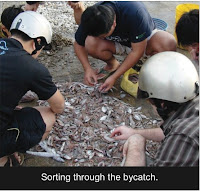
         The markets we visited (more than 20 in all) were mostly small artisanal fisheries from local fisherman collecting on the South China Sea. The fishes that we were collecting were not always being sold at the market but were often part of the rubbage pile of bycatch. As in most cases the bycatch piles are chock full of strange fishes that no one would purchase for their dinner. It was in these piles that we collected odd silvery eels, fatheaded jawfishes, fleshy dark deepsea fishes, and numerous other oddities that we ichthyologists crave. The markets themselves were also remarkably diverse matching the diets of the locals. You know if the Vietnamese weren’t eating them that the fish must look very strange.
         Matt, who the Taiwanese referred to as “Max” the entire trip, was after some of the fish he studied during his dissertation, in particular the lizardfishes. Lizardfishes include cigar-shaped predatory fishes that dwell along the bottom of the continental slope to depths of around 200 meters. Of particular note were specimens collected of the only mesopelagic lizardfish genus Harpadon, commonly known as the “Bombay Duck” and found only in the Indo-Pacific. (The nickname comes from Indian restaurateurs trying to make the fish sound more appetizing to British diners.) Dried Harpadon is considered a delicacy in parts of Asia, and indeed we often spotted hundreds of dried out specimens lying on the street, a sight that would make Matt cringe each time. In the end we managed to procure quite a few fresh specimens, including a potentially new species that exhibits sexual dimorphism.
Near the end of the trip we went out collecting on the Mekong Delta. It took some work getting to the Mekong and hiring a boat but once aboard we would ask our driver (ask as in point to a boat and to a picture of a fish) to take us toward the small fishing boats trawling the Mekong. It was by trading with boatman that we collected some of the most interesting freshwater and brackish water specimens. Nearly every specimen collected is new to the LSU collection, and some are certainly new to science. The products of the trip will be additional materials for our on going projects on the family level phylogenies of some notable deepsea, bioluminescent, and otherwise poorly studied Western Indo

Wednesday, September 12, 2012

Measuring the Environmental Impact of the Gulf Oil Spill


November 2010
 
The oil spill in the Gulf of Mexico was the largest accidental release of oil in history with over 4.9 million barrels (=206 million gallons) released; however, accessing the actual environmental impacts will be very difficult. The largest environmental impact is likely to take place in the part of the world that is most unfamiliar to us and the least studied - the deep sea.
         The well associated with the Deepwater Horizon rig was nearly a mile (1.6 km) below the surface; everything below 1 km from the ocean’s surface is considered the deep sea. This environment is the largest most stable habitat on Earth; it is perpetually in darkness (no sunlight penetrates this region) and is always cold (only 1 to 2°C above freezing). The animals that live there are subject to enormous pressure (hundreds of pounds per inch) and also have to deal with vast amounts of empty space (prey items and mates are difficult to find). These difficult conditions have led to the evolution of some strange-looking organisms. Adaptations for this environment include flashing lures, fleshy black bodies, giant teeth and eyes, and generally odd body shapes and behaviors (see photos on page 4). The majority of animals that live here use bioluminescence (light generated from bacterial symbionts or by the animal itself) to communicate and to attract prey. The common perception that the deep sea is depauperate in terms of species richness and diversity is wrong. The most abundant vertebrate species in the world live in this habitat (lanternfishes, Neoscopelus spp.; bristlemouths, Cyclothone spp.) as do some of the rarest and most bizarre forms known. There are more than 2,000 fish species known from the deep sea (more than all the birds, amphibians and reptiles of North America). One hypothesis of the origin of deep-sea fishes is that the deep ocean is a refuge for the living remnants of primitive lineages that were outcompeted by more advanced forms in ecologically rich habitats like coral reefs. Giving credence to this idea is the fact that advanced spiny-rayed fishes (Acanthomorphs), which make up the majority of extant fishes, are generally absent from the deep sea despite their complete dominance of every other aquatic habitat. Therefore, despite the perception of the deep sea being an ecological desert, it is in fact very rich.
         When the decision was made to allow the release of chemical dispersants below the surface at the source of the oil spill a trade off was being made between two environmental disasters. Allowing all of the oil to come directly to the surface (by not using dispersants) would have meant potentially having the Louisiana shoreline and its fragile marsh and estuarine habitats threatened. Allowing dispersants to be sprayed a mile below the surface meant endangering the deep-sea habitat where the damage would go largely unseen. In the end, we have oil in both habitats. Dispersants had never before been used below the surface and little data exists about how these chemicals breakdown and how they interact with the deep-sea environment. The dispersants that were used, Corexit 9500 and 9527, degrade quickly in warm waters when exposed to sunlight: it is not known how these chemicals break down in the dark and cold deep ocean. There is also no way of dealing with subsurface oil: oil at the surface can be skimmed and burned, treated and broken down. Even if we could treat subsurface oil, it would be difficult to find. We have inadequate tools for discovering oil floating in the water column as either tiny suspended microdroplets or as dense deep-sea plumes. We frankly do not know how long oil combined with dispersants will remain in the environment. We do know that the combination of high atmospheric pressure and darkness certainly allows the oil to be maintained in the deep sea much longer than it can in warm surface waters.
         To study the impact of the oil spill on the Gulf environment, my lab and collaborators at Ohio State University (PI - Daniel Janies) have created a program called SpeciesMap. This program maps the known pre-spill distributions of fishes in the northern Gulf of Mexico (where there are about 600 species known) based on historical records from museum collections (including LSU’s) and the collections of state and federal agencies. These georeferenced data can be incorporated into a NOAA map of the oil spill, and it can be used to compare post-spill and pre-spill distributions (see map above). SpeciesMap provides the user a way to visualize where fishes were collected before the spill and compare collections post-spill to see if any species have been extirpated from certain locations or if they are less abundant than in the past. We can incorporate data about life history to see if spawning grounds have been affected or if migratory routes have changed. SpeciesMap is freely available on-line (http://speciesmap.org) and we have reached our goal of mapping all northern Gulf fishes (see map above for an example). For many species of northern Gulf fish we know little else besides their distributions. This program will help determine if the oil spill permanently changed this environment or if it will quickly rebound.
         My post-doctoral fellow, Matthew Davis, and I have also submitted an NSF proposal to study the deep-sea environment and how it was established. We are targeting three taxonomic groups: batfishes (Ogcocephalidae), cods (Gadiformes), and lizardfishes (Aulopiformes). These groups are notable because they are some of the few lineages that have representatives in the deep sea and in shallow waters. Because of that diversity we can study how the deep sea was invaded and what adaptations need to take place in order to accommodate that transition. The batfishes are a family of anglerfishes that have an unusual flattened body shape that make them look more like moldy crackers with eyes than they do fish (see image on top). This is a group I’ve been interested in ever since moving to Louisiana. Two colleagues, Hsuan-ching Hans” Ho (Academica Sinica, Taiwan) and John Sparks (American Museum of Natural History) and I recently described two new species of pancake batfish from the Gulf of Mexico. These are the two newest species described from the region and one of them is only found off the coast of Louisiana and northern Texas. Amazingly, of the more than 1500 or so fish species found in the Gulf only 73 are endemics (found no where else). This new endemic species, that we call the Louisiana Pancake Batfish (Halieutichthys intermedius), has received a lot of press coverage because of its incredible beauty and because it was discovered in the region of the oil spill.
         The deep sea is home to an amazing diversity of rare and odd forms with many yet to be discovered and many other secrets to be revealed. As we learn more about the effects of the largest environmental disaster in U.S. history we should keep in mind how difficult measuring that impact will really be. The only thing we know with certainty is the fact that we still know very little.

Ichthyological Adventures in Central America Part 1: Collecting Fishes in Costa Rica


May 2011

From February 15 to the 24th the freshwater people in my lab (Caleb McMahan, Dr.Wilfredo Matamoros) and I went on a trip to collect fishes in Costa Rica. Marine postdoctoral fellow, Dr.Matt Davis, was left back in Baton Rouge to hold down the fort. (Don’t worry he will go to Panama with the rest of the lab in March and April, while I stay behind with my very pregnant wife.) Caleb, Will and I were after cichlids, poeciliids (livebearers) and other freshwater species that are related to my NSF funded project in Central America.
         This was my first freshwater collecting trip to Central America in six years and I learned quickly that my team was much better at this than I was and even better than I thought I was. Caleb has been collecting heavily from freshwaters in Mexico, the U.S. and Jamaica for his masters and undergraduate projects and Wilfredo (without exaggeration) is one of the most well respected collectors of Central American fishes alive today. Wilfredo has many years of experience collecting in remote parts of Central America, which is why I brought him aboard as a postdoctoral fellow this past fall. Also with us were two superior Costa Rican collectors, Arturo Anguilo Sibaja and Carlos Garita Alvarado. These two master’s students from the Universidad de Costa Rica were tremendous collectors and they knew many remote sites where we could collect. They were also very intelligent young gentleman who we made fun of constantly (they did the same to us with less success). In the eight days that we were sampling fishes we put nearly 1000 miles on our rented vehicle in a country that has a coastline of 1100 miles. We collected in every major drainage, in 26 localities, and in six out of the seven provinces as we circumnavigated the entire country.
         We collected about 90% of our targeted species. Our final tally was nearly 4000 specimens from over 150 species. It was one of the most successful collecting trips I’ve ever been on, which was a surprise given how we started. After a couple of days of getting settled in San Jose getting our rental car and gear together, we started our drive to the southern Pacific slope in the province of Puntarenas. We arrived just as the sun was setting and found ourselves a nice little beach hotel (one of many Hotel Iguanas that we encountered) with Golfo Dulce and the Pacific just to our west and with Panama to the east. We decided we would sample that night right in the back of the hotel, which was conveniently located on the beach. Although we were primarily after freshwater fishes, marine fish were also on our mind particularly mullets (Mugilidae) a taxon Caleb has an unusual, and perverse, fondness for. After about an hour at the beach we had collected a marine catfish, a spadefish (Ephippidae) a rare threadfin (Polynemidae) and several other species. It was already 9pm and I was toast, but the site of fish made the blood lust come out of Caleb and Will and they decided that we needed to hit a freshwater site, the Rio Coto, that night. The entire time the strange hotel manager was following us around and he even helped (sort of) pull seines on the beach. As we headed off to the Rio Coto he grabbed a couple of beers and hopped into the back of our SUV.
         As I started recording GPS coordinates and writing field notes the UCR students started pulling a seine in the shallows near shore, almost immediately Arturo cried out in pain. He climbed out of the water with a nasty gash across his foot, he said he was pinched by a crab but it looked much worse than anything a crab could impart. He went to lie down and to elevate his foot while we stoically carried on with the fishing, we ended up getting an additional 10 species at that site after about half-an-hour. We called it quits around 10pm with the intention of returning the next morning. Back at the hotel the arduous work of sorting, photographing, IDing, tissue-ing, and labeling began. One of the unfortunate things about collecting is the necessity of processing these materials while fresh. The hotel manager, now completely drunk, did not make things go faster with his bad jokes and shenanigans but any hotel owner who didn’t mind us laying out 100 or so muddy fish across his bathroom floor surrounded by razor blades and alcohol vials is an okay guy in my book. Not to mention the olfactory nightmare that the mix of formalin, ETOH, fish, sweat, beer, and Arturo’s bleeding foot produced. I’m not sure when we got done that night, but as it was with the rest of the trip, we were off early the next morning before we could get too relaxed.
         We didn’t actually catch a cichlid until our eighth field site on the third day of collecting, a fact that had me very worried since we were there primarily to collect members of this family. Cichlids are very species rich in Central America, with over 100 species, and this family has been there for a long time (more than 50 million years in some parts if you believe my publications). Because they are obligate freshwater fish, cichlids can tell us about the history of the geological blocks that make up Central America. Central America is a landbridge that connects North and South America that has only been in its present arrangement of four interconnected geological blocks for the past three million years. The geological blocks are older but their arrangement and the movement of those blocks over the course of the last 60 million years is hotly debated among geologists. The history and phylogenetic relationships of cichlids and other freshwater fishes on these landmasses can tell us a great deal about which geological hypotheses make the most sense. The biological data provide an independent line of evidence for supporting or rejecting the geological theories. Our plan was to collect as many cichlids and other freshwater species as possible. Although we didn’t collect any cichlids at first they started coming in bunches after day three. We ended up with 20 of the 22 species of cichlids we were targeting. It was amazing to see how each river drainage had its own assemblage of endemics. Cichlids are gorgeous fish, almost all have brightly colored bodies and fins and many have blue or lightly colored eyes. (This coloration is why they are among the most popular aquarium fish.) Even though we were not traveling tremendous distances between sites we could see huge differences between upland and lowland sites and between Pacific and Caribbean coasts. Costa Rica is one of the most developed countries in Central America so it was great to see that the diversity of forms were still there. In fact, we know of at least two new species that we are planning on describing. In July Arturo and Carlos will be coming to LSU to help us describe those species and to determine if we have even more new taxa.
Besides the upcoming Panama trip my lab will also be traveling to Nicaragua, Guatemala, El Salvador, Mexico and Honduras over the next few months. Stay tuned....